Tuesday, 11 August 2015

MATHS WEEK 2015 - Day 2 Problms

Here are your challenges for Tuesday:

Junior Problem


Miss Breen has baked chocolate chip cookies for her family.  Her son sneakily eats 5 of them when she isn't looking. Her son has eaten one quarter (1/4) of the cookies. How many cookies does Miss Breen have left for the rest of the family?

Senior Problem


Emma is making 2 pizzas. She cuts each of her pizzas into sixths.  She has 36 pieces of pineapple to spread evenly on her 2 pizzas.  How many pieces of pineapple will be on seven/sixths (7/6) of the pizzas?


Students: Write your answer in the comments area with your name/class
Teachers: please send photos of student thinking to Miss Breen :-)

Good Luck!

Come back tomorrow for new challenges!


Here is a photo of student thinking (senior problem) in Room 7 today:


Here are some photos of Room 18 working hard on the junior problem today:


Monday, 10 August 2015

MATHS WEEK 2015 - Day 1 Problems

Maths Problems for 2015 Maths Week


JUNIOR PROBLEM - Monday

A group of bees are out collecting nectar to make honey. 6 of the bees are on flowers and the other half return to the hive. How many bees return to the hive?


Write your answer with your name/class in the comments area :-)

-------------------------------------------------------------------------------------

SENIOR PROBLEM - Monday

Our school has a practice fire drill, the bell continually rings. 25 students are still in class, the other seven eighths (7/8) of the school's students are already lined up on the courts. How many students are on the courts?


Write your answer with your name/class in the comments area :-)


GOOD LUCK!

COME BACK TOMORROW FOR NEW CHALLENGES!

Friday, 12 June 2015

ShowMe Some Learning

The other day I introduced some of my students to the ipad app 'ShowMe' which is an interactive whiteboard. As we have been focusing on patterns in algebra, this app gave my students the chance to share how they work out the continuing sequence of a pattern.


*The copy-master pattern in the video comes from the unit plan Letter Patterns on the NZmaths website.


In the video by Tyrell and Moengaroa (group 3), they are explaining the sequence of the pattern and they come up with a rule which they can use to work out larger numbers in the sequence. As this was their first time using the App they didn't explain as thoroughly as they normally do to their group but I think they did great!


Below is some problem solving work around patterning by Tyrell, Foloi and Katrina


Our teachers create and share within our school three level word problems, as we are currently involved in the Mathematical Inquiry Communities (MIC) with Bobbi Hunter and Massey University. This problem was originally created by Matua Tuiono, Mr Lysaght and Miss Tafa here at Clendon Park School though I have altered the numbers for my students.


1   1. At the first CPS Home School Partnership evening 7 people turned up. The second year 12 people turned up. The third year 17 people turned up. How many people turned up in the eighth year? (What is the pattern?/What is the rule?)

 .  2. How many people turned up in the seventeenth year?

    3. How many people turned up in the thirty second year?

*The first picture shows their workings for question 1 & 2 and the second picture shows their working for question 3. As you can see by coming up with a rule in the first question they were able to quickly find how many people would have turned up in the 17th and 32nd year.  The pattern was +5 and their rule was  x5 + 2. The +2 comes from the first number in the sequence which is the only number that isn't +5 (7-5 = 2) They also noticed that the numbers all ended in 2 and 7 so they could easily predict the next number.


Friday, 29 May 2015

What's the Pattern?

My students have just starting exploring the early stages of algebra and exploring algebraic thinking using colours, shapes, symbols, numbers, letters etc to begin to identify patterns and relationships, which is a key to being successful in mathematics.

Here are some links to pattern games for your child or students to practise: 

Click on the link:
Finish the Pattern
Pattern Farm
Here are some photos of my year 4 group (group 1) creating their own repeating patterns:


Working in a class

Each week I relieve in a year 2/3 class so for one day I get to practice problem solving with a class rather than with my small groups. 

This class was split into half and one half works independently in Maths while the other half works with me. They are given a word problem and are asked to read it and talk about what they can see in their heads and what the problem is asking them to do. Once they have had a think, pair, share with their buddy we come back as a group to talk about the problem and also the rules when working with a buddy. This is to ensure that all the students are clear about what the problem is and the expectations before they start trying to solve it. Once we have had a whole group discussion, the students are given a chance to try to work it out. At this stage most students generally choose to use materials such as beans, counters or ice block sticks to help them. 

Here are some photos of the students problem solving:


Tuesday, 12 May 2015

Measurement

Hello, it has been a while since my last post so I'm trying very hard to catch up on posting about my students. My groups have been working hard for the past couple of weeks learning about measurement using both non standard and standard units.

I have been using ideas from measurement units that can be found on http://nzmaths.co.nz/length-units-work I have found them very valuable and have been altering them or adapting them to suit my students and where they are at.

We have been mainly looking at length and width. 

Group 3 and 5 have been looking at estimations, length, width, benchmarks, surface area, distance, total distance, average, centrimetres and metres to name just some. They have made paper planes (see unit http://nzmaths.co.nz/resource/paper-planes-level-2) which they flew against each other and then were asked to measure the distance, work out total distance, average flight distance etc. They used measuring tapes for this which meant they had to convert metres into centimetres. 

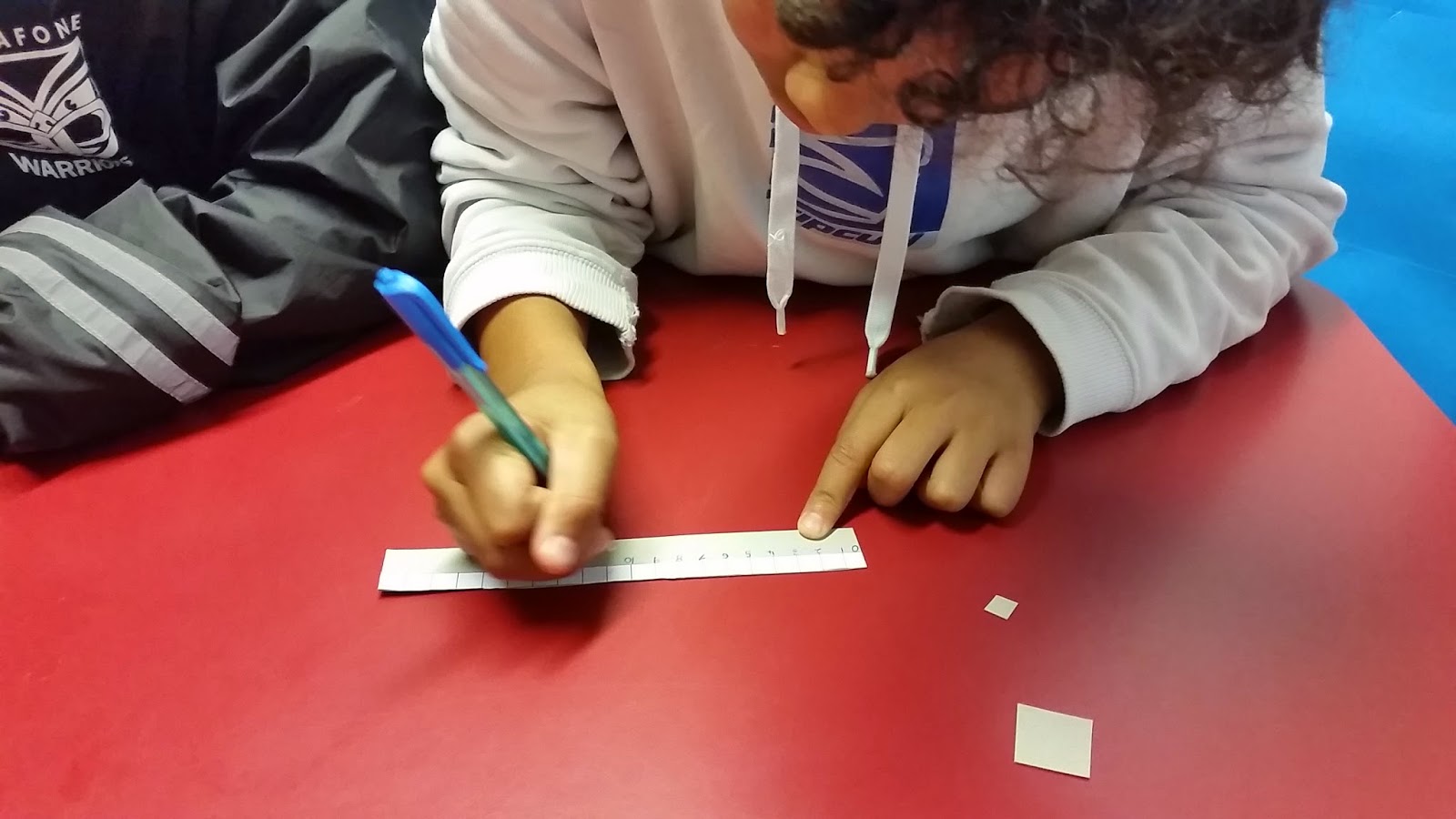
Group 1, 2, 4 have been doing a lot of work around estimations, length, width, non standard units i.e. pencils, hand spans, blocks etc moving on to 1cm cubes, 10cm blocks and making their own rulers. 

Most of the activities have been very hands on which has helped to engage the children in the learning.

The next step will be problem solving with a measurement context.

Below are some photos of my various groups learning about measurement recently: