Tuesday, 12 May 2015

Measurement

Hello, it has been a while since my last post so I'm trying very hard to catch up on posting about my students. My groups have been working hard for the past couple of weeks learning about measurement using both non standard and standard units.

I have been using ideas from measurement units that can be found on http://nzmaths.co.nz/length-units-work I have found them very valuable and have been altering them or adapting them to suit my students and where they are at.

We have been mainly looking at length and width. 

Group 3 and 5 have been looking at estimations, length, width, benchmarks, surface area, distance, total distance, average, centrimetres and metres to name just some. They have made paper planes (see unit http://nzmaths.co.nz/resource/paper-planes-level-2) which they flew against each other and then were asked to measure the distance, work out total distance, average flight distance etc. They used measuring tapes for this which meant they had to convert metres into centimetres. 

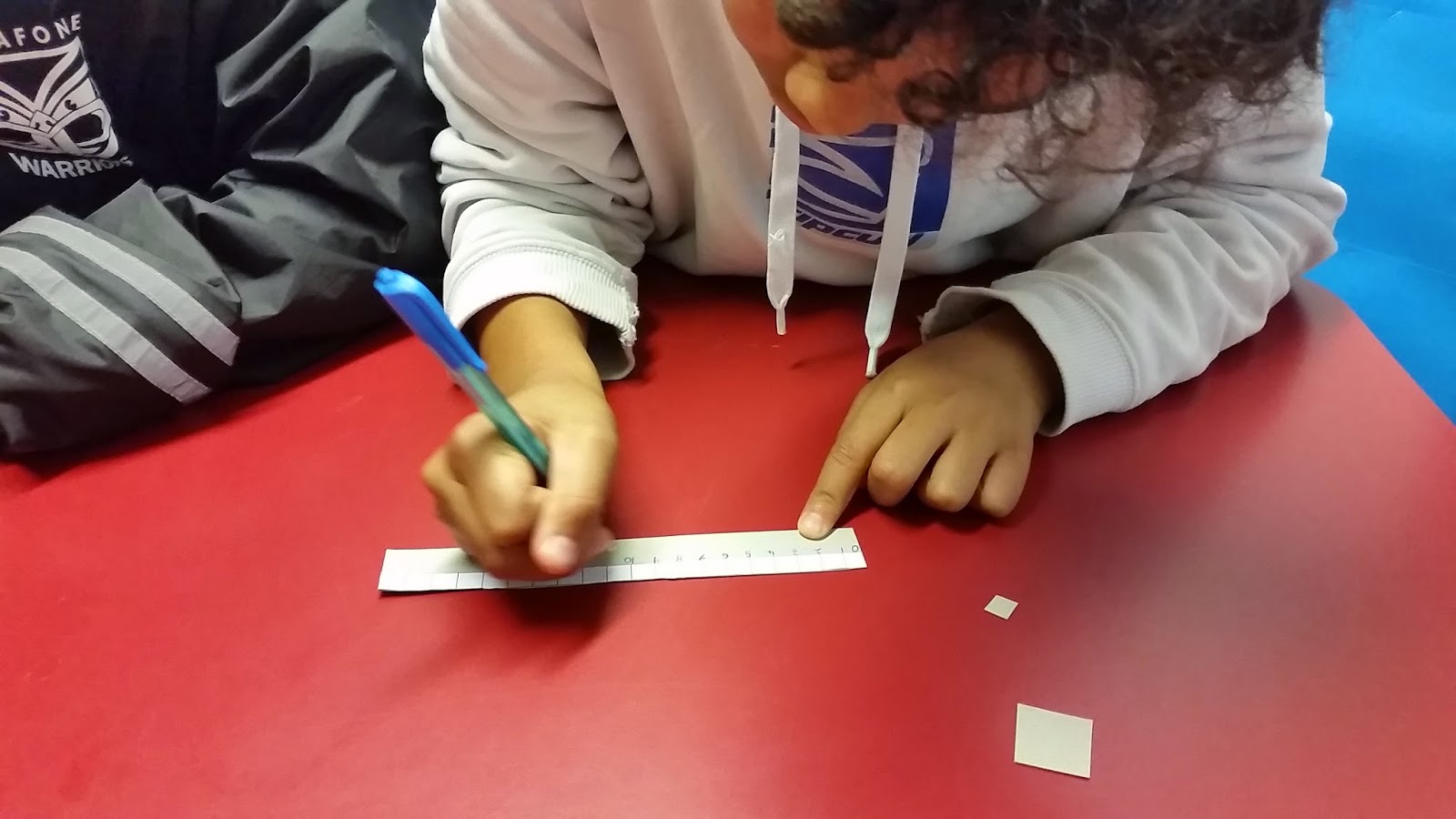
Group 1, 2, 4 have been doing a lot of work around estimations, length, width, non standard units i.e. pencils, hand spans, blocks etc moving on to 1cm cubes, 10cm blocks and making their own rulers. 

Most of the activities have been very hands on which has helped to engage the children in the learning.

The next step will be problem solving with a measurement context.

Below are some photos of my various groups learning about measurement recently:




Friday, 27 March 2015

Mini Workshop

I haven't had much time to post in the last few weeks as I've been busy working on developing my student's abilities to work in small groups together and to explain and justify mathematically in order to problem solve. 

Today we were a little stretched for time so I did a mini workshop with Group 2 around basic fractions. They loved this as they got to write on the table with whiteboard markers. We were looking at halves and quarters of shapes and then sets. 

I asked them, "If I have 16 counters and that is my whole, can you draw what halves would look like? Quarters? (and for those that finished quickly) Eighths? I asked them to write an equation next to their representation which proved that the pieces made the whole.

Here are my girls next to their work:


Thursday, 12 March 2015

Creating Problem Solvers

Everyday when my students work with me they are challenged with Mathematical word problems. They are put in mixed ability groups within their main group and asked to solve a problem given to them anyway they can this includes using materials if they so choose. My students can find this very challenging at times but as they get more practice on how to approach these problems they are really working their hardest to get the right answer. They have such expressions of accomplishment when they do manage to work out tricky problems, which is so great to see.

Here are some photos of my groups working on problems. They are concentrating hard :-)


Tuesday, 10 March 2015

Introducing My Students!

For the first half of this year I am working with 5 fabulous groups of students. Below are some photos of my groups. More will be added soon.


Wednesday, 28 January 2015

Welcome to 2015

This year I will once again be working with many wonderful children to help accelerate their learning in Mathematics. Please check back regularly as I will be posting teaching strategies and activities I use with my Maths groups and the learning journey of my students.

Miss Breen :-)

P.s. Here is the yearbook page with all my fantastic kids from last year.


Thursday, 16 October 2014

Fractions of sets

This term I am focusing on Fractions, Decimals and Percentages with my students. The students are started to see the connection and relationship between these three areas i.e. that 0.2 is the same as 20% which is the same as 1/5. They are also learning how to simplify fractions and about equivalency at the same time.

So on Monday we started using paper strips to work out the fraction of a certain number of chocolate bars each person would get.

Example:
Miss Breen has 4 Chocolate bars left over at the end of the school term. She wants to share them out with the 5 children that were the best helpers that week. How much chocolate will each child get?

The paper strips helped the students to think about the chocolate bars as wholes before they broke them up into fractions and shared them out. We had a few tries, much trial and error before they began to realise that it was a good idea to start by breaking each whole paper strip into the number of people from each problem.

Once the students understood that each problem related to parts of a whole we moved onto the fractional equations. The students were still free to draw pictures but they began to use multiplication and division as a way to work out their answers.

Here are some photos from this week, of the students from all my groups working on these types of problems.

p.s. I let my kids draw on the tables with Whiteboard markers, it makes for a great working space :-)


Understanding Fractions - Group 7

Today I asked Group 7 (Yr 5/6) to show me fractions in more than one way (multiple representations). This group of students are lacking understanding of the key idea that fractions is about parts of a whole. They are learning that the whole could be five, the whole could be 100, the whole could be a set of objects (discrete), just repeated numbers added together, or even a shape (continuous) but they can all show the same fractional number related to the whole.

In the photos below I asked the students to show me four quarters, this is only the beginning of these lessons so as they progress we will use other materials as well so that they get experience of fractions in many forms.

  • The multi-link cubes stuck together are fractions of a shape 
  • the groups are fractions in sets 
  • The numbers represent equal sharing creating a whole using numbers